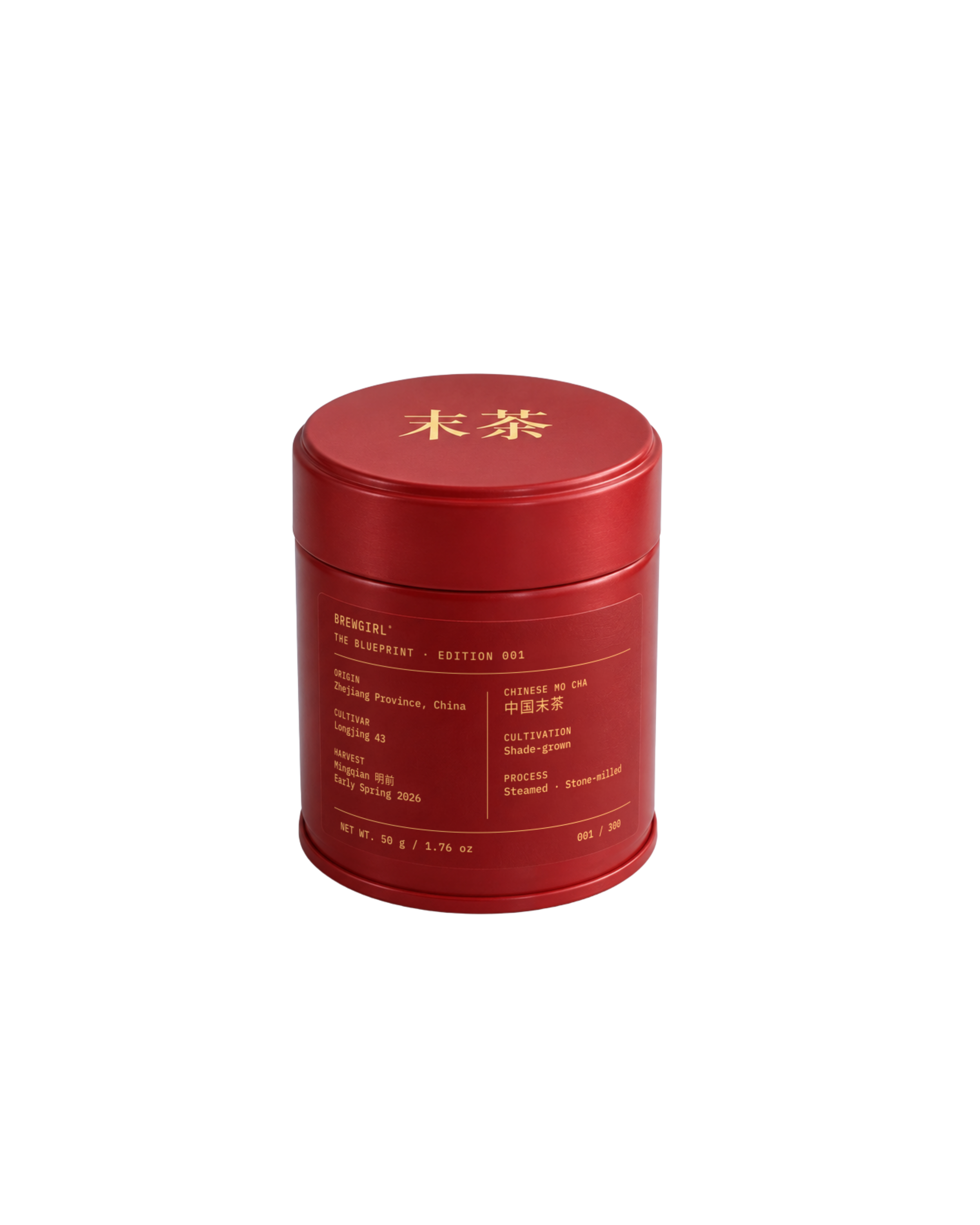
Made in China. Made in the blueprint.
A study of origin, authorship, and the three words the world learned to underestimate.
The history earns the credit. The record earns the trust.
Blueprint
origin.
茶
Before matcha was matcha, there was 末茶 mò chá.
Between c. 760 and 780, Lu Yu’s Cha Jing described powdered tea among the forms of tea known in Tang China.
By the Song dynasty, from 960 to 1279, powdered tea had become a disciplined art. Tea was pressed into cakes, then ground fine. Sifted into a bowl. Met with hot water. Whisked with bamboo until pale foam spread across the surface.
Dark Jian bowls were prized because their glaze made that white foam visible. In 1107, Emperor Huizong documented the practice in Da Guan Cha Lun, his treatise on tea.
This was not yet the modern matcha sold today. It was the system beneath it.
The powder
Powdered tea · Tang dynasty
Cha Jing, c. 760 to 780
The bowl
Jian teabowl · Song dynasty
12th to 13th c. · Jian kilns, Fujian
The bamboo whisk
Chá xiǎn · Northern Song
Documented c. 1107 to 1110
China built the blueprint.
末茶
Song dynasty · 960 to 1279
Where the whisk first moved.
The blueprint traveled.
Tea knowledge moved from China to Japan through centuries of religious, diplomatic and cultural exchange.
In 1191, Eisai returned from Song China with tea seeds and what he had learned. In Japan, the inherited powdered-tea practice developed over centuries into the shade-grown, tencha-based modern matcha and chanoyu recognized today.
China built the foundations. Japan developed the modern form.
This edition brings the modern form back to where the foundation began.
Before the tin was opened, the country had already been judged.
When we said our first matcha would come from China, the questions arrived before the tasting. They were not responding to the tea. They were responding to three words:
Chinese matcha?
Are you sure?
Will people want it?
Made in China.
Somewhere along the way, those words became shorthand for less.
That assumption is the subject of this project.
Chinese matcha is already produced and exported at scale. Much of it enters the global ingredient market in kilos, blends and formulations. Along the way, its origin rarely reaches the customer.
China was trusted to make it. Not trusted to be named on it.
Not as fine print. Not as an explanation. Not as something the product must overcome. As provenance.
So we went to the source.
We went to Zhejiang. To the fields. To the production floor. To the people growing the leaf. To the people shaping what it becomes.
We followed the tea through cultivation, harvest, steaming, refining, milling and packing. We asked what could be traced, what could be documented and what deserved to appear on the label.
The closer we came to the work, the clearer the project became.
China was never something to hide behind the product.
China was the point.
A country name is not a quality grade.
Quality lives in the specific lot: the cultivar, the harvest, the shading, the processing, the freshness, the taste.
We are not asking you to believe this tea is good simply because it is Chinese. We are showing you exactly why this Chinese tea is good.
A shade-grown Chinese matcha from Zhejiang Province, made from Longjing 43 and harvested before Qingming in early spring 2026.
- Origin
- Zhejiang Province, China
- Cultivar
- Longjing 43
- Harvest
- Mingqian 明前, early spring 2026
- Process
- Steamed · stone-milled
- Year
- Fire Horse · 丙午 · 2026
- Cultivation
- Shade-grown
The answer is not to hide the origin. It is to make the work visible.
China made more than products. China made foundations.
China is credited with these foundations in history books. That credit rarely follows the name onto a label today.
The Blueprint is about that gap.
Tea is the first entry.
One edition each year.
Twelve years. Twelve animals.
Edition 001 belongs to the Fire Horse 丙午, a pairing that returns once every sixty years. The last was 1966. The next will be 2086.
Individually numbered 001-300
This edition will not be reprinted
When it’s gone, edition 001 closes
- Why begin in China?
- Because the foundational powdered-tea system, the powder, the bowl and the bamboo whisk, was developed there. China also deserves to have the quality of its present-day work judged through evidence rather than assumption.
- Are you saying China invented modern matcha?
- We are saying precisely what the history supports: China created the foundational powdered-tea practice. Japan later developed those foundations into modern matcha. Naming the Chinese foundation does not erase the Japanese development. Both belong in the history. Edition 001 tells the chapter that is too often left out.
- Why do you use both 末茶 and 抹茶?
- 末茶, mò chá, appears in historical Chinese writing and refers to powdered tea. 抹茶, mǒ chá, is the modern term for matcha, read in Mandarin when discussing present-day Chinese matcha. On this site, 末茶 names the historical chapter and 抹茶 names the product inside the tin.
- Is Chinese matcha lower quality?
- A country is not a quality grade. Quality must be assessed lot by lot: cultivar, harvest, shading, processing, freshness and taste. We publish the record of this lot so this edition can be judged by its work, not by an assumption attached to its origin.
- Why do you not call it “ceremonial grade”?
- Because ceremonial grade is not a universal, regulated quality standard. We would rather tell you what can be checked: where the tea grew, which cultivar it came from, when it was harvested, how it was shaded and how it was processed.
- Why only 300 tins?
- Because The Blueprint is an archive, not permanent inventory. Each annual edition is numbered once and then closed. Edition 001 will not return.
History deserves receipts.
The historical claims in The Blueprint are supported by primary texts and institutional sources, including:
- Lu Yu, Cha Jing / The Classic of Tea, c. 760 to 780
- Emperor Huizong, Da Guan Cha Lun / Treatise on Tea, 1107
- Song-dynasty Jian tea-bowl records and museum collections
- Five College Center for East Asian Studies, History of Tea · 栄西禅師 Eisai Zenji, 1191
- Ministry of Agriculture, Forestry and Fisheries of Japan, Uji Tea · 16th c. onward
- Modern production and export records for China’s matcha industry
Not an alternative.
The origin.
Chinese matcha does not need to arrive as a substitute, a compromise or a lesser version of somewhere else. It can stand on its own origin. Its own people. Its own craft. Its own evidence. Edition 001 does exactly that.
300 numbered tins